Smartphone photography has reached remarkable heights, and the driving force behind this evolution in 2025 is Artificial Intelligence (AI). Modern smartphones are no longer just passive cameras; they are intelligent devices that use AI to understand scenes, enhance images, and optimize every shot for stunning results. With the latest camera hardware paired with cutting-edge AI algorithms, 2025’s smartphone models are transforming how users capture and experience photos and videos. Here’s how AI is revolutionizing smartphone photography in the newest models this year.
Intelligent Scene Recognition and Optimization
One groundbreaking AI feature is real-time scene recognition. Using deep learning, smartphones now identify various scenes—be it landscapes, portraits, food, or night shots—and automatically adjust settings like exposure, contrast, saturation, and white balance to suit the environment.
For example, the Google Pixel 10 series uses Tensor G5’s advanced AI to differentiate faces from backgrounds and enhance skin tone while preserving natural textures. Similarly, Vivo’s V60 5G with ZEISS optics employs AI to detect low light or movement and dynamically optimize the image.
AI-Powered Computational Photography
Computational photography uses algorithms to overcome physical limitations of small smartphone lenses. This year:
- Night mode captures multiple exposures and combines them for bright, noise-free images. AI aligns frames perfectly, even when slightly moving.
- HDR enhancements dynamically balance shadows and highlights with more precision.
- AI algorithms improve depth mapping for sharper bokeh in portraits by better distinguishing background vs. subject.
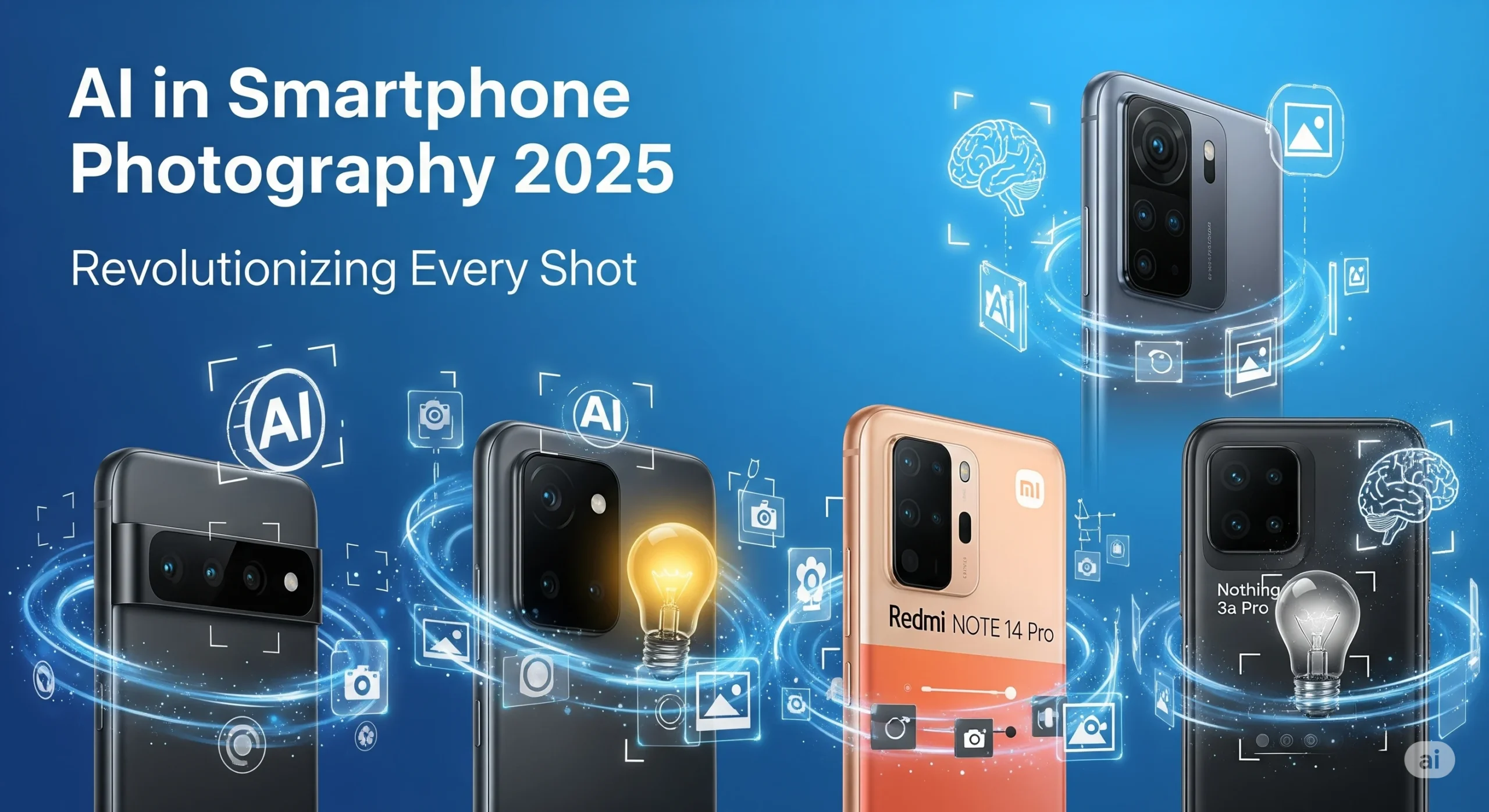
Phones like the Redmi Note 14 Pro and Nothing Phone 3a Pro heavily rely on AI for computational super-resolution, enabling ultra-detailed shots from smaller sensors.
Real-Time AI Video Enhancements
AI improvements are not limited to photos but also extend to video:
- Real-time video stabilization corrects shakes and jitters smoothly during handheld recording.
- AI-powered auto-frame tracking keeps subjects centered during movement, perfect for vloggers and casual creators.
- Automatic color grading and lighting adjustments happen live, improving vibrancy and mood without post-editing.
The Samsung Galaxy Z Fold 5, for instance, uses AI-powered multi-camera control to switch between lenses and optimize scenes while filming.
AI-Based Post-Processing and Editing
Modern smartphones offer AI-assisted editing tools such as:
- AI Erase for removing unwanted objects or people from photos effortlessly (found on Vivo and Xiaomi devices).
- Smart enhancements that adjust brightness, sharpness, and noise reduction automatically for best results.
- AI-powered portrait relighting changes lighting directions after taking photos, giving professional-looking effects.
Google’s Pixel lineup continues to lead here with its user-friendly tools that intelligently suggest edits while preserving the photo’s original feel.
Personalized Photo Styles and Modes
AI tailors photography to individual styles and preferences by learning from user interactions:
- Phones remember favorite modes and automatically suggest scene-optimized filters that match your taste.
- AI-driven beauty modes adjust smartly to avoid unnatural smoothening while enhancing details.
- Advanced HDR modes personalize tone mapping based on typical user feedback.
This personalization enhances usability and satisfaction, making photography accessible for all skill levels.
Multi-Camera AI Integration
In 2025 models, AI seamlessly integrates outputs from multiple lenses:
- AI chooses the best camera or merges images from wide, ultra-wide, and telephoto sensors for perfect photos.
- Switching between cameras is automatic and adaptive to lighting and distance.
- Phones like the Honor Magic V2 Fold or Vivo V60 5G use AI to harmonize colors and exposure across lenses.
This results in consistent professional-level photography regardless of which camera you use.
Impact on the User Experience
AI is simplifying the photography journey on smartphones drastically:
- Novices can take stunning photos without manual adjustments.
- Enthusiasts gain new creative tools and AI-powered automation for better shots.
- Everyday users enjoy faster processing and reliable outcomes.
Today’s AI doesn’t replace the photographer’s eye but amplifies creative possibilities by handling technical challenges seamlessly.
The Future of AI in Smartphone Photography
Looking ahead, AI will continue pushing boundaries:
- Integration with augmented reality (AR) to add real-world depth data for richer photos.
- Predictive AI suggests shots before you capture based on context and movement.
- Enhanced on-device neural processing makes real-time edits even faster and more precise.
As AI advances, smartphone photography will keep evolving into an art form accessible to everyone.
Conclusion
AI is the heart of 2025’s smartphone photography revolution. It empowers devices from Google, Vivo, Samsung, Xiaomi, and Nothing to deliver exceptional images effortlessly. Whether through intelligent scene detection, computational tricks, or smart editing, AI ensures every click can be masterpiece-worthy. For anyone buying a phone in 2025, AI-powered cameras are no longer a luxury but a core expectation, making creativity and professional-looking photos possible for all users.